S.r.l.s. in Italy: Capital, the Standard Deed and When the Status Ends

S.r.l.s. stands for società a responsabilità limitata semplificata, a simplified private limited company built for a founder who is a natural person and willing to sign a deed nobody can rewrite afterwards. The statute fixes the capital between EUR 1 and just under EUR 10,000, waives the notary fee on the deed, and hands the founder a ministerial template in place of a bespoke set of articles (Art. 2463-bis c.c.). The trade goes further than most guides admit. Sell a quota to a company rather than a person and, under a 2016 ministry ruling, the S.r.l.s. status can disappear the same day, replaced by an ordinary low-capital S.r.l. Every figure below carries the article that states it, so it can be checked independently of us.
Giulia Mancini, Head of Corporate Formation, Milan. Giulia started out preparing incorporation deeds in a Milan notary practice and has spent twelve years since watching founders choose a company form before they have read the deed that comes with it. More
Reviewed by Alessandro Ferri, Tax and Accounting Lead. Updated 11 September 2026.
What is an S.r.l.s. in Italy?
Most readers meet the abbreviation before they meet the statute behind it.
S.r.l.s. stands for società a responsabilità limitata semplificata
S.r.l.s. stands for società a responsabilità limitata semplificata (simplified private limited company), created by Art. 2463-bis of the Codice civile (Civil Code). The company may be incorporated by contract between several founders or by the unilateral deed of one. The deed itself takes the form of a public deed before a notary, drawn up on a standard model the ministry sets.
Where the S.r.l.s. sits among Italian company types
The S.r.l.s. is not a rival to the S.r.l., it is a way of being one. Everything the statute does not spell out for the simplified form falls back on ordinary S.r.l. law, so far as compatible. A founder choosing a company form in Italy across all eight Italian types will meet the S.r.l.s. one level below the plain S.r.l., a variant rather than a sibling. The comparison that trips up most guides, S.r.l.s. against an S.r.l. with capital under EUR 10,000, gets its own section further down this page.
A single founder is allowed
One person is enough. The statute allows incorporation by contract or by unilateral deed, and the National Council of Notaries confirms it in plain English: the company may be composed of a single shareholder. See Consiglio Nazionale del Notariato: Simplified S.R.L..
How many S.r.l.s. companies exist in Italy
427,322 simplified companies sat on the Register of Companies in the National Council of Notaries' publication of 18 March 2026, against 400,520 recorded at 31 December 2024. Lazio holds the largest stock, ahead of Campania, Lombardia, Sicilia and Puglia. The notaries publish these figures every year because the fee exemption obliges them to, but they do not report what share of new companies the form represents, so no percentage appears here.
What this guide does not cover
Three questions belong elsewhere. Comparing every Italian form on the merits sits with the pillar above; incorporating a company as a service, for a founder who wants to register a company in Italy without a purpose-built page for every form, sits on the home page. Calculating IRES, IRAP and IVA belongs to the tax silo, and this page gives rates only, on the corporate tax page. Whether an S.r.l.s. can hold startup innovativa (innovative startup) status is not addressed here at all: the standard deed's rigidity makes the question genuinely open, and it stays with the innovative-startup page rather than being guessed at here.
How much capital does an S.r.l.s. need?
Capital is the attribute that carries almost all of this form's identity.
The band: at least EUR 1 and below EUR 10,000
The capital sits between two round numbers and never touches the upper one. Art. 2463-bis(2)(3) of the Civil Code puts it exactly: pari almeno ad 1 euro e inferiore all'importo di 10.000 euro, at least EUR 1 and below the amount of EUR 10,000, referring back to the ordinary S.r.l. threshold in Art. 2463(2)(4). The National Council of Notaries renders the ceiling in practical terms as "a minimum share capital of one euro and a maximum of €9,999.99." Everything above that figure belongs to a different regime, covered later on this page. See Normattiva: D.M. 155/2022 and the text of Art. 2463-bis c.c..
Paid in full, in cash, on the day of incorporation
No 25% shortcut exists here. An ordinary S.r.l. can call in a quarter of the cash contributions and settle the rest later; an S.r.l.s. cannot. The same subsection that sets the capital band also requires it sottoscritto e interamente versato alla data della costituzione, subscribed and paid in full on the date of incorporation. Equipment, a laptop, a trade mark, none of it counts: il conferimento deve farsi in denaro, the contribution must be made in money, full stop.
Who the money is paid to
The statute sends the capital all'organo amministrativo, to the management body, not to a bank. In person, that means no Italian account has to exist before the deed is signed. By video conference the rule flips: the money goes instead to the notary's dedicated account, the one exception carried forward later in this guide.
Table: S.r.l.s. at a glance
| Indicator | Value | Provision |
|---|---|---|
| Minimum capital | EUR 1 | Art. 2463-bis(2)(3) c.c. |
| Maximum capital | below EUR 10,000 (EUR 9,999.99) | Art. 2463-bis(2)(3) c.c.; notariato.it EN |
| Payment on incorporation | 100%, on day one | Art. 2463-bis(2)(3) c.c. |
| Form of contribution | cash only | Art. 2463-bis(2)(3) c.c. |
| Payee of the capital | management body in person; notary's dedicated account online | Art. 2463-bis(2)(3) c.c.; Art. 2(1) D.Lgs. 183/2021 |
| Founders | natural persons only | Art. 2463-bis(1) c.c. |
| Single founder | allowed | Art. 2463-bis(1) c.c. |
| Age limit | none, since 23 August 2013 | Art. 9(13)(a) D.L. 76/2013 |
| Directors must be members | no, since 23 August 2013 | Art. 9(13)(b) D.L. 76/2013 |
| Standard-model clauses | non-derogable, since 23 August 2013 | Art. 2463-bis(3) c.c.; Art. 9(13)(b-bis) D.L. 76/2013 |
| Items the deed must state | 6, plus 4 cross-references to Art. 2463(2) | Art. 2463-bis(2) c.c. |
| Stamp duty and secretarial fees | exempt, on the deed and the entry | Art. 3(3) D.L. 1/2012 |
| Notary fee on the deed | none due | Art. 3(3) D.L. 1/2012 |
| Supervision of the exemption | Consiglio Nazionale del Notariato, annual publication | Art. 3(4) D.L. 1/2012 |
| Notary's filing deadline | 10 days | Art. 2330 c.c. |
| Register entry deadline | 10 days, 5 if electronic | Art. 11(8) D.P.R. 581/1995 |
| Legal personality | on entry in the register | Art. 2331 c.c. |
| S.r.l.s. inserted into the Civil Code | in force 25 March 2012 | Art. 3 D.L. 1/2012 |
| Standard model adopted | in force 29 August 2012 | D.M. Giustizia 138/2012 |
| Current text of Art. 2463-bis in force since | 23 August 2013 | Art. 9 D.L. 76/2013 |
These are the statute's own thresholds, deadlines and exemptions, not the cost of any professional service. Our own fees are quoted on request.
What must the deed of an S.r.l.s. say, and what can never be changed in it?
The deed follows a list the statute writes itself, not a list the parties negotiate.
The six items the statute itself lists
Article 2463-bis(2) sets out six things the deed must state, and it is a closed list:
- each member's surname, first name, date and place of birth, domicile and citizenship;
- the corporate name, carrying the words società a responsabilità limitata semplificata, and the comune of the seat and of any secondary seats;
- the capital figure, at least EUR 1 and below EUR 10,000, subscribed and paid in full in cash, already covered above;
- the four items borrowed from the ordinary S.r.l., set out next;
- the place and date of subscription;
- the directors, named with no further qualification.
The four items borrowed from the plain S.r.l.
Item four of that list is itself a cross-reference. It pulls in numbers 3, 6, 7 and 8 of Art. 2463(2): the activity that forms the corporate object, each member's share of participation, the rules on how the company operates and who represents it, and the persons entrusted with administration, together with any statutory auditor. Nothing else migrates across. A contribution in kind, for instance, has no home in either list.
Why no clause can be added or changed
One sentence carries the whole trade-off: Le clausole del modello standard tipizzato sono inderogabili, the clauses of the typified standard model are non-derogable. Drag-along and tag-along rights, separate classes of quota, bespoke quorums, tailored pre-emption, none of it fits inside a deed that cannot be varied. See Normattiva: D.M. Giustizia 138/2012, which sets the model itself and the residual rules that fill in what it leaves silent.
A stale check the notary still has to make on paper
One provision has not caught up with the law around it. D.M. 138/2012 still instructs the notary to verify che l'età delle persone fisiche fits the age bracket set by Art. 2463-bis, a check with nothing left to verify once that age limit was repealed in 2013, as the next section shows. Normattiva shows the decree unamended since 2012. Read it as a fact about two texts that have drifted apart, not as advice: no age limit applies today.
What changed in 2013, and why some guides still get it wrong?
Half of what circulates about this form describes law that no longer applies.
The original 2012 text: under 35, directors must be members, no transfers outside the bracket
The article did not always read the way it does now. From 25 March 2012, D.L. 1/2012, Art. 3 restricted the S.r.l.s. to founders che non abbiano compiuto i trentacinque anni di età, who had not yet turned thirty-five, banned selling a quota to anyone outside that bracket on pain of nullity, and required directors to be chosen from among the members.
One comma, three repeals and one new rule, dated 23 August 2013
All three restrictions left the Code on the same day. See Normattiva: D.L. 76/2013, Art. 9, in force from 23 August 2013. It deleted the age words from comma 1, deleted the members-only rule for directors from comma 2, deleted the transfer ban that had been comma 4, and inserted the sentence that makes the standard-model clauses non-derogable. One comma of one decree did all four things at once.
The same article created the ordinary S.r.l. at EUR 1
The decree did not stop at the S.r.l.s. The short-lived S.r.l. a capitale ridotto (S.r.l. with reduced capital) was abolished, and existing companies of that kind were reclassified as S.r.l.s. outright. S.r.l. capital payments moved from a bank to the management body, matching the S.r.l.s. rule already in force. And the same comma created the ordinary S.r.l. below EUR 10,000, the form this page compares itself against further down.
Timeline. 25 March 2012, Art. 2463-bis enters the Code → 29 August 2012, the standard model takes effect → 23 August 2013, the three repeals and the non-derogability rule → 15 December 2021, video-conference incorporation opens → 5 November 2022, the uniform English-language models take effect.
What this means for anything you read that is older than 2013
Any English guide that still states an age ceiling of 35, or a rule that S.r.l.s. directors have to be members, is describing law that stopped applying on 23 August 2013. The date is checkable against Normattiva, and it is the quickest way to tell an outdated source from a current one.
When does an S.r.l.s. stop being an S.r.l.s.?
Nobody selling the S.r.l.s. tends to mention how a founder can accidentally end it.
A quota can be sold to a legal person
The restriction on founders bites only once, at the start. Answering the Chamber of Commerce of Ancona on 15 February 2016 (prot. 39365), the ministry then called MISE, now MIMIT, held that a quota sale to a company is valid, because the ban in Art. 2463-bis(1) riguarda la sola fase di costituzione della società, concerns only the incorporation stage. See MIMIT: parere 15 February 2016, prot. 39365.
But the company loses its S.r.l.s. characteristics
Validity comes at a cost. The same parere goes on: where there is no capital increase past EUR 9,999, l'ingresso nel capitale sociale di soggetti differenti dalle persone fisiche fa perdere a quella srl le caratteristiche di srl semplificata, the entry of anyone other than a natural person makes the company lose its S.r.l.s. characteristics, and Art. 2463(4) of the Civil Code takes over instead.
The name must drop "semplificata"
The company becomes, in the ministry's own phrase, an ordinary S.r.l. a capitale esiguo, with low capital, and it must strike semplificata from its name because the word no longer matches reality and would mislead the market. MIMIT explains why the word was compulsory in the first place: the S.r.l.s. non rappresenti un tipo autonomo di società… ma un mero modo d'essere della società a responsabilità limitata, is not an autonomous company type but a way of being an S.r.l., and the name carries a warning to third parties.
Step 1: a quota is sold to a legal person. Step 2: the S.r.l.s. characteristics are lost. Step 3: Art. 2463(4) c.c. applies. Step 4: the name loses "semplificata". Source: MIMIT, parere of 15 February 2016, prot. 39365, to the Chamber of Commerce of Ancona.
What does not trigger a loss of status
Not every amendment does this. The ministry was also asked about changing the corporate object and answered that the status survives where the change non si pongono in contraddizione con la formulazione dell'art. 2463-bis, does not contradict Art. 2463-bis. The company stays an S.r.l.s., but the full updated text of the deed still has to be filed after any amendment, not only a summary of the change.
The three triggers, side by side
Three events, and only three, end an S.r.l.s.:
- a person other than an individual acquires a quota;
- capital is raised to EUR 10,000 or above;
- a clause the standard model cannot contain becomes necessary.
The third is the one that has to be caught before incorporation, not after. It rules the form out at the planning stage rather than converting it later.
Is it true that an S.r.l.s. is free to set up?
The exemption is real, but it is narrower than the marketing around it.
What the exemption actually names
Three items, and the statute names them precisely: L'atto costitutivo e l'iscrizione nel registro delle imprese sono esenti da diritto di bollo e di segreteria e non sono dovuti onorari notarili, the deed and the register entry are exempt from stamp duty and secretarial fees, and no notary fees are due. See Normattiva: D.L. 1/2012, Art. 3.
Who checks that notaries apply it correctly
The National Council of Notaries polices the exemption and publishes the figures every year, the same duty behind the register-stock numbers cited earlier on this page. The notaries confirm the English version of the rule without qualification: "No notarial fees are payable."
What is not covered: the chamber fee, later filings, the registration tax
Three items are exempt, and only three. The annual chamber fee is not among them. Filings made after incorporation are not among them. The registration tax is not among them either, and here the statute is genuinely silent: it names stamp duty, secretarial fees and notary fees, and it does not say one way or the other whether the imposta di registro applies to an S.r.l.s. deed. This page states what Art. 3(3) D.L. 1/2012 exempts and stops there, rather than asserting a figure that has no source behind it.
What a newly registered company pays in year one regardless
A fixed diritto annuale (annual chamber fee) of EUR 120.00 falls due on registration for a newly formed capital company. In later years the fee moves to a turnover scale, with the fixed base at the lowest band reduced by half, and a 20% surcharge running across 2026, 2027 and 2028. See CCIAA Marche: diritto annuale 2026.
S.r.l.s. or an ordinary S.r.l. at EUR 1: which is the real comparison?
The comparison that actually matters is not the one most guides make.
Two routes, one decree, the same day
Both regimes trace to the same comma of the same decree. Art. 9 D.L. 76/2013, covered above, repealed the S.r.l.s. restrictions and, in the same breath, created a low-capital route inside the ordinary S.r.l., the most common form among Italian company types. The two routes are contemporaries, not competitors from different eras.
What the ordinary route buys: a free hand on the deed and a corporate member
The ordinary route still asks for cash paid in full at incorporation, exactly like the S.r.l.s. What it buys back is everything the standard model forbids: a deed drafted to order, a corporate founder rather than individuals only, and any clause a lawyer cares to add.
What the ordinary route costs: duty, fees and a permanent reserve
Flexibility is not free. At least one fifth of net profit goes to a reserve every year until reserve plus capital reach EUR 10,000, a duty the S.r.l.s. never carries. The counter adds a fixed EUR 200 registration tax, EUR 156.00 in stamp duty on the deed and a EUR 90 secretarial fee on registering it. An S.r.l.s. escapes the stamp duty and the secretarial fee outright, under its own exemption above. Whether it escapes the registration tax too is not settled by any source we could confirm, so this page states the ordinary route's bill in full and leaves that one line open for the S.r.l.s. side.
Founders: S.r.l.s. individuals only; ordinary S.r.l. at EUR 1, individuals or a company. Deed: S.r.l.s. fixed standard model, non-derogable; ordinary S.r.l., freely drafted. Capital band: both EUR 1 to under EUR 10,000. Payment: both 100% on day one. Cost at the counter: S.r.l.s., stamp duty and secretarial fee exempt, registration tax not settled; ordinary S.r.l., EUR 200 registration tax plus EUR 156.00 stamp duty plus EUR 90 secretarial fee. Reserve: S.r.l.s., none; ordinary S.r.l., at least one fifth of net profit every year until capital plus reserve reach EUR 10,000. Both routes trace to Art. 9 D.L. 76/2013; the S.r.l.s. is not the only way into Italy at EUR 1.
The fork in one line
One route buys flexibility and pays for it in duties and a standing reserve. The other buys the exemption and pays for it with a deed nobody may edit and founders who must be individuals. Neither is cheaper in the abstract, only in different currencies.
Can a non-resident set up an S.r.l.s. without travelling to Italy?
A seat in Italy does not require a founder to be there in person.
The two conditions: an Italian seat and cash capital
Video conference is open to the S.r.l. and the S.r.l.s. alike, on two conditions: the seat has to be in Italy, and the capital has to be cash. The notary receives the deed as an atto pubblico informatico (electronic public deed), with the parties joining through a platform the National Council of Notaries builds and runs. Nothing about the form itself changes: the same capital band, the same standard model and the same fee exemption apply whether the deed is signed in a Milan office or over a video call from abroad. See Normattiva: D.Lgs. 183/2021, Art. 2.
Where the money goes online, and why it differs from an in-person deed
Remote incorporation moves the payee. In person, the capital goes to the management body, as covered earlier on this page. By video conference it goes instead by bank transfer to the notary's dedicated account, the single exception this guide carries forward from that earlier section.

When a notary must accept the call, and when they can stop it
A notary must take the deed whenever every party lives outside Italy. The same rule cuts both ways: a notary can interrupt the video call and require physical attendance where identity is in doubt, or where the rules on capacity to act, or to represent a company, are not met.
An official English-language deed model, chamber by chamber
Annex 2 to D.M. 155/2022 is the S.r.l.s. model itself, titled "Modello SRL SEMPLIFICATA," and every chamber of commerce has published it, in English as well as Italian, since the decree took effect on 5 November 2022. See CCIAA Marche: the standard online models and Consiglio Nazionale del Notariato: Simplified S.R.L.. Genoa's chamber, among others, serves a live copy of the English model.
How does an S.r.l.s. get on the Register of Companies?
Registration runs on statutory deadlines, not on how quickly paperwork moves.
The notary's 10-day filing
Once the deed is signed, the clock starts running immediately, ahead of any of the register formalities that follow. The notary has ten days to file it with the Register of Companies, whatever route was used to sign it (Art. 2330 c.c.).
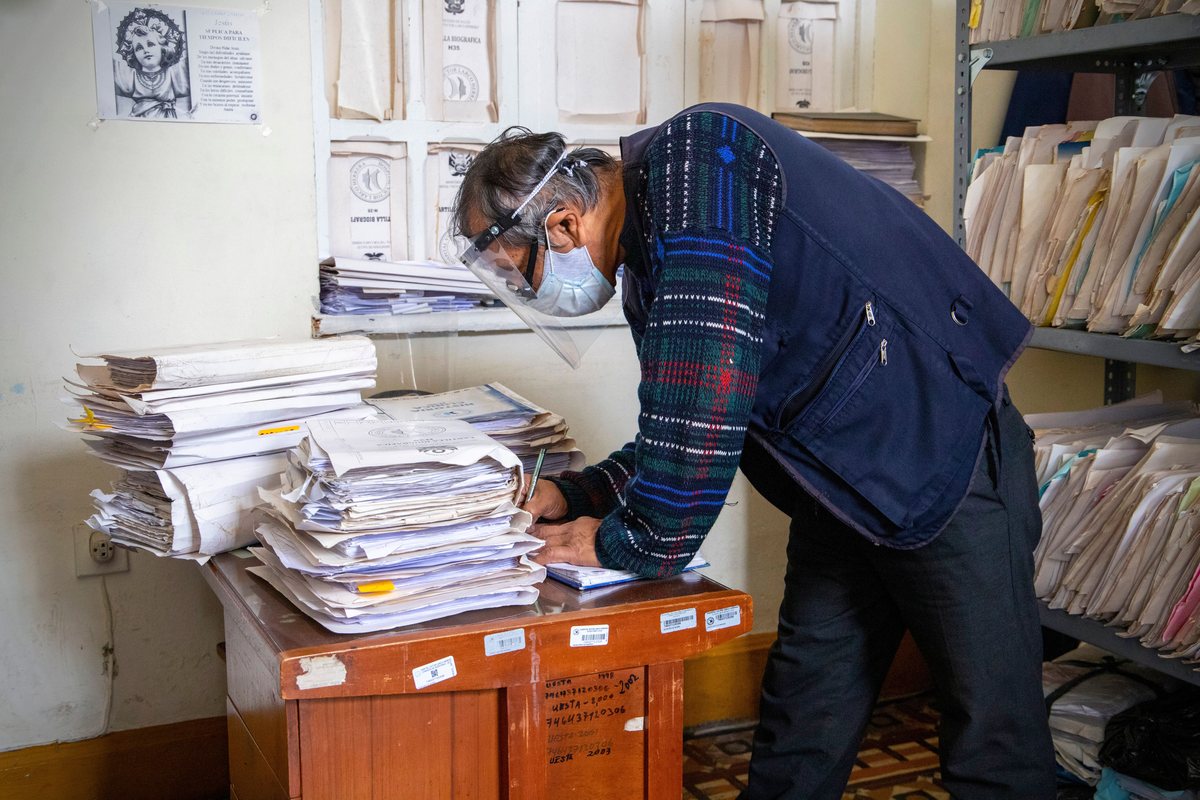
One filing, four authorities: Comunicazione Unica
One package covers four authorities at once: the Register itself, the codice fiscale (tax code) and partita IVA (VAT number) through the Agenzia delle Entrate, INPS and INAIL. See Registro Imprese: Comunicazione Unica. That procedure is still in force. What changed on 12 February 2026 was the ComUnica software, replaced by DIRE or equivalent market software; the single-filing procedure itself never stopped working.
The register's own deadline
The chamber of commerce then has ten days from protocol to make the entry, halved to five days where the filing arrives electronically, a difference worth knowing before choosing how to file.
Legal personality on entry, not on signature
The company exists as a legal person from the moment of that entry, not from the moment the deed was signed (Art. 2331 c.c.). A founder who has signed but not yet been entered is, legally, not yet dealing through a company at all.
What ongoing duties does an S.r.l.s. carry after registration?
Incorporation is the start of the paperwork, not the end of it.
The permanent publicity duty
The obligation does not end at incorporation. The full form name, the capital subscribed and paid, the seat and the register office all have to appear on documents, correspondence and the company's public electronic space, indefinitely. This is one of the few duties the statute states specifically for the S.r.l.s. rather than borrowing from the ordinary S.r.l.
The director's personal domicilio digitale
Since 31 December 2025, the sole director, the managing director or, failing either, the chairman of the board must hold a personal certified digital domicile distinct from the company's own (Art. 13(3) D.L. 159/2025). The requirement bites on every new appointment and every renewal from that date forward, not only on companies formed afterwards.
Electronic invoicing through the SDI
Every company with an established partita IVA invoices electronically through the Sistema di Interscambio (SDI, the exchange system), and an S.r.l.s. is no exception.
The sole member's liability trap
A single owner carries a specific risk. Where the whole quota has belonged to one person and the company becomes insolvent, that person answers without limit for the period in question if the contributions were not made as Art. 2464 requires, or if the publicity required by Art. 2470 was skipped. The rule applies to an S.r.l.s. exactly as it applies to any other S.r.l., because Art. 2463-bis borrows the ordinary S.r.l. chapter for everything it does not state itself.
What taxes does an S.r.l.s. pay?
Rates only: the calculation and the filing calendar sit on the tax pillar.
IRES at 24%
An S.r.l.s. is an S.r.l. for tax purposes, in line with the ministry's own description of the form as a way of being one rather than a distinct type. Company income is taxed at IRES 24%. See Agenzia delle Entrate: IRES for companies for the mechanics, and how Italian company tax works for the full calculation and the returns.
IRAP at 3.9%, with regional variation
IRAP applies at 3.9%, and individual regions may move that rate by up to 0.92 percentage points either way.
IVA at 22%, reduced 4/5/10%
IVA runs at 22% standard, with reduced rates of 4%, 5% and 10% for specific categories of goods and services, from basic foodstuffs to certain construction work. Neither the mechanics nor the filing calendar belong on this page: both sit on the tax pillar linked above.
When is an S.r.l.s. the wrong choice?
Some structures rule the S.r.l.s. out before a single document is drafted.
Any licensed activity with a capital floor at or above EUR 10,000
Licensing arithmetic rules the form out on its own. MiCA sets prudential minimums for a crypto-asset service provider at EUR 50,000, EUR 125,000 or EUR 150,000, depending on the class of service, every one of them above the S.r.l.s. ceiling. See EUR-Lex: Regulation (EU) 2023/1114, Annex IV. The two capital rules cannot both be satisfied, whatever else a licence application requires.
Any structure that needs a corporate founder or a bespoke clause
Two more situations close the door before incorporation even starts: a corporate parent joining at formation, which the individuals-only rule does not allow, and any clause the standard model has no room for. A holding structures arrangement usually needs both.
What to look at instead
The ordinary S.r.l. at EUR 1 answers the corporate-founder and bespoke-clause problem directly, as covered above. For a larger venture, one with outside investors or a board structure, when an S.p.A. makes sense instead of an S.r.l. sets out the alternative worth reading next.
Frequently asked questions
What is an S.r.l.s. in Italy?
A societa a responsabilita limitata semplificata, a simplified version of the private limited company, incorporated by individuals on a fixed ministerial deed model. Legal personality arises on entry in the Register of Companies, not on signature.
How much capital does an S.r.l.s. need?
At least EUR 1 and below EUR 10,000, subscribed and paid in full, in cash, to the management body on the date of incorporation. There is no 25% option, unlike the plain S.r.l.
Is it true that setting up an S.r.l.s. is free?
The deed and the register entry are exempt from stamp duty and secretarial fees, and no notary fees are due. Only those three items are named: the annual chamber fee and the fees on every later filing are not among them.
Can a company be a shareholder of an S.r.l.s.?
Not at incorporation. A later transfer to a legal person is valid and registrable, but MIMIT holds that the company then loses its S.r.l.s. status and must drop semplificata from its name.
Is there still an age limit of 35 for founders?
No. Those words were repealed by Art. 9(13) D.L. 76/2013, in force from 23 August 2013, along with the rule that directors had to be members.
Can the articles of an S.r.l.s. be changed?
The standard-model clauses are non-derogable. An amendment that does not contradict Art. 2463-bis, a change of corporate object for instance, is possible, and the full updated text must then be filed.
What happens if the capital is raised to EUR 10,000?
The capital ceiling of the form is exceeded, so the S.r.l.s. regime no longer fits and the company continues as an ordinary S.r.l.
S.r.l.s. or an ordinary S.r.l. at EUR 1: which is the real comparison?
The ordinary S.r.l. can also start at EUR 1 and allows a freely drafted deed and a corporate member, but it carries stamp duty, a secretarial fee, a notary fee and a reserve of at least one fifth of profit.
Can an S.r.l.s. be set up without travelling to Italy?
Yes, by video conference on the notaries' platform, provided the seat is in Italy and the capital is cash; a notary must take the deed if every party lives outside Italy, and an official English-language model exists.
Can an S.r.l.s. hold a crypto-asset or payment licence?
In practice, no: the capital must stay below EUR 10,000, while MiCA sets a crypto-asset service provider minimum of EUR 50,000 to EUR 150,000. The two requirements cannot both be satisfied.
Is an S.r.l.s. a separate type of company?
No. MIMIT describes it as a way of being an S.r.l., not an autonomous company type, and the compulsory word semplificata exists to warn third parties that the deed is the untouched standard model.
How many S.r.l.s. companies are registered in Italy?
427,322 on the register in the National Council of Notaries' publication of 18 March 2026, against 400,520 at 31 December 2024. The notaries do not publish the share of new companies this represents.